A Man Crossing the Atlantic Before History Arrived
Rephotographing a 1979 silver halide portrait of Joe aboard the Queen Elizabeth 2
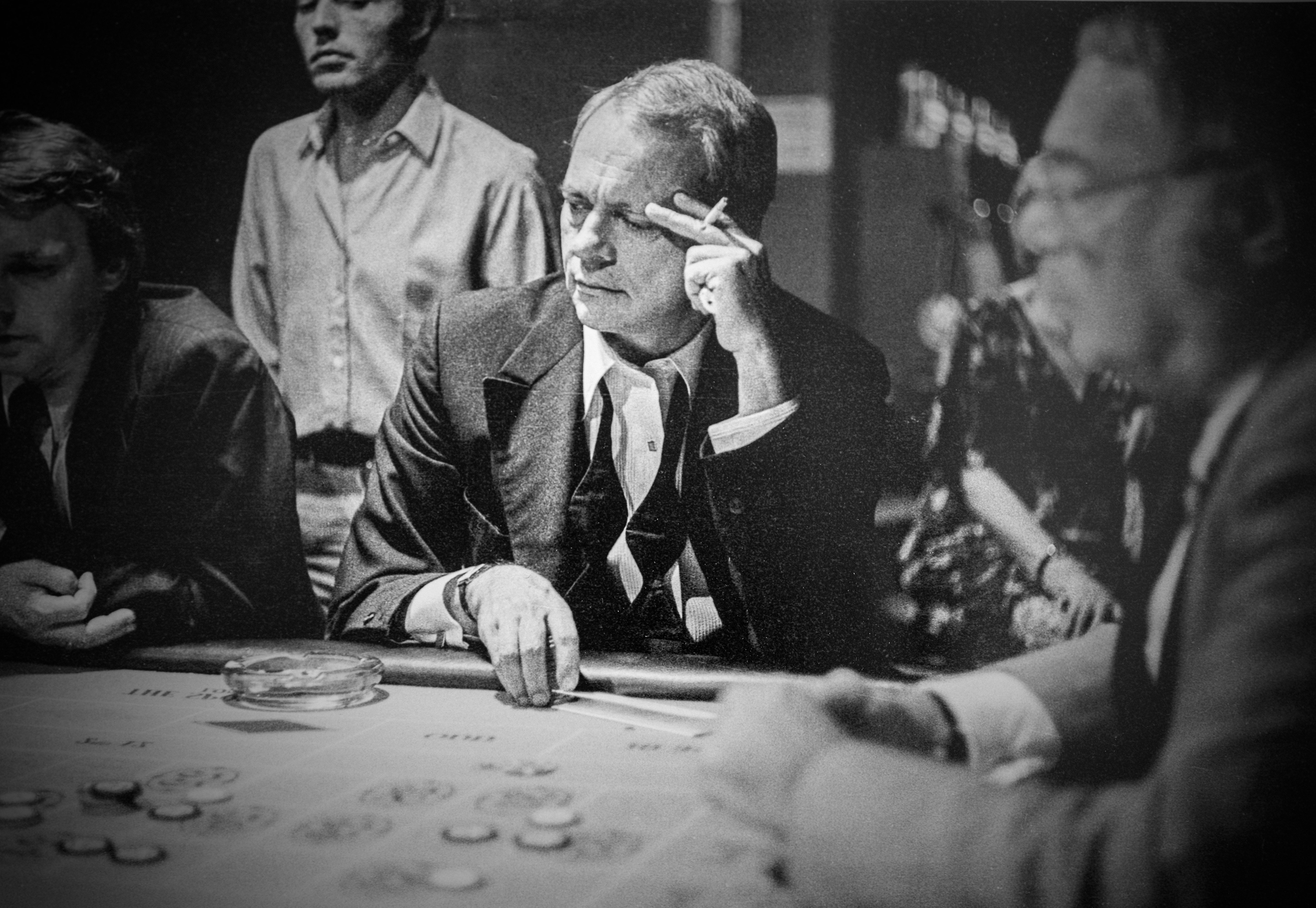
The photograph was taken aboard the Queen Elizabeth 2 during a transatlantic crossing from New York to Southampton in 1979 by the photographer Lisa Howe-Ebright. The man seated at the casino table, cigarette raised to his temple in a gesture somewhere between concentration and exhaustion, was named Joe. He was a friend of Lisa’s. Years later, he died of AIDS.
The original photograph was made on a Leica M using black and white film. Decades later, I digitally rephotographed a 35mm silver halide print of the image using a Leica Q3 43. What interests me is not simply the preservation of the photograph, but the strange temporal layering that occurs when an image is seen again through another camera separated from the original moment by nearly half a century.
In its original context, the photograph would likely have appeared unremarkable to those present. A man in a casino aboard an ocean liner. Cigarette smoke. Gambling chips. The dim glamour of late-1970s transatlantic travel. Yet time alters photographs in ways no photographer can entirely predict. Images survive their original purpose. They accumulate meanings never intended by either subject or photographer. What was once immediate becomes archaeological.
What arrests me most about the photograph is Joe’s isolation within the composition. Though surrounded by people, he appears psychologically detached from the room around him. The other figures drift toward obscurity, blur, or shadow, while he remains sharply anchored at the center of the frame. Even the casino itself recedes into darkness. The image behaves less like social documentary and more like an unintended elegy.
Knowledge changes photographs. Or perhaps more accurately, history changes photographs. Knowing Joe would later die during the AIDS epidemic transforms the image without reducing it to tragedy. The photograph does not announce catastrophe. Nothing within the frame signals what is coming. That is precisely what gives it force. It contains a future invisible to everyone present at the table.
The cigarette, the tailored jacket, the atmosphere of shipboard luxury, the casual physicality of the scene now belong to a vanished social world. Not merely because styles changed, but because an entire generation would soon encounter a historical rupture few could imagine in 1979. Looking at the image now, one becomes conscious of how often photography captures people standing unknowingly at the edge of events that will later redefine them.
What interests me equally is the physical journey of the image itself. The original negative became a silver halide print. The print aged. The print accumulated surface texture, tonal shifts, and the subtle evidence of material existence. I then rephotographed that object digitally. The resulting image is therefore not a reproduction in the conventional sense. It is a photograph of a photograph carrying the visible residue of time between both acts of seeing.
This matters because photography is often discussed as though it freezes time. In reality, photographs continue changing long after exposure. Their meanings shift as people die, cities disappear, technologies vanish, and history rewrites the emotional atmosphere surrounding the image. The photograph remains physically static while interpretation remains permanently unstable.
The slight softness at the periphery of the frame, the tonal blooming within the grain, and the optical imperfections introduced through age and rephotography all contribute to this instability. Rather than diminishing the image, these characteristics make it feel remembered rather than merely viewed. The photograph resists sterile archival clarity. It feels touched by time.
There is also something profoundly moving in the survival of ordinary moments. Joe was not posing for posterity. Neither he nor Lisa Howe-Ebright could have anticipated that decades later someone would again raise a camera to this image and look at him across nearly fifty years. Yet photography permits these improbable continuities. The dead return not as abstractions, but as visible presences suspended inside light, grain, chemistry, and paper.
What ultimately remains in this photograph is neither nostalgia nor mourning. Nostalgia simplifies the past into sentiment. This image refuses that simplification. Instead, it presents something far more unsettling and far more human: the realization that every photograph contains realities its subjects themselves cannot yet see.
- Will Hazlitt, New York
Original photograph:
Rephotograph:
Will Hazlitt
Studio Assistant:
Michael Viktor Kilarjian


