

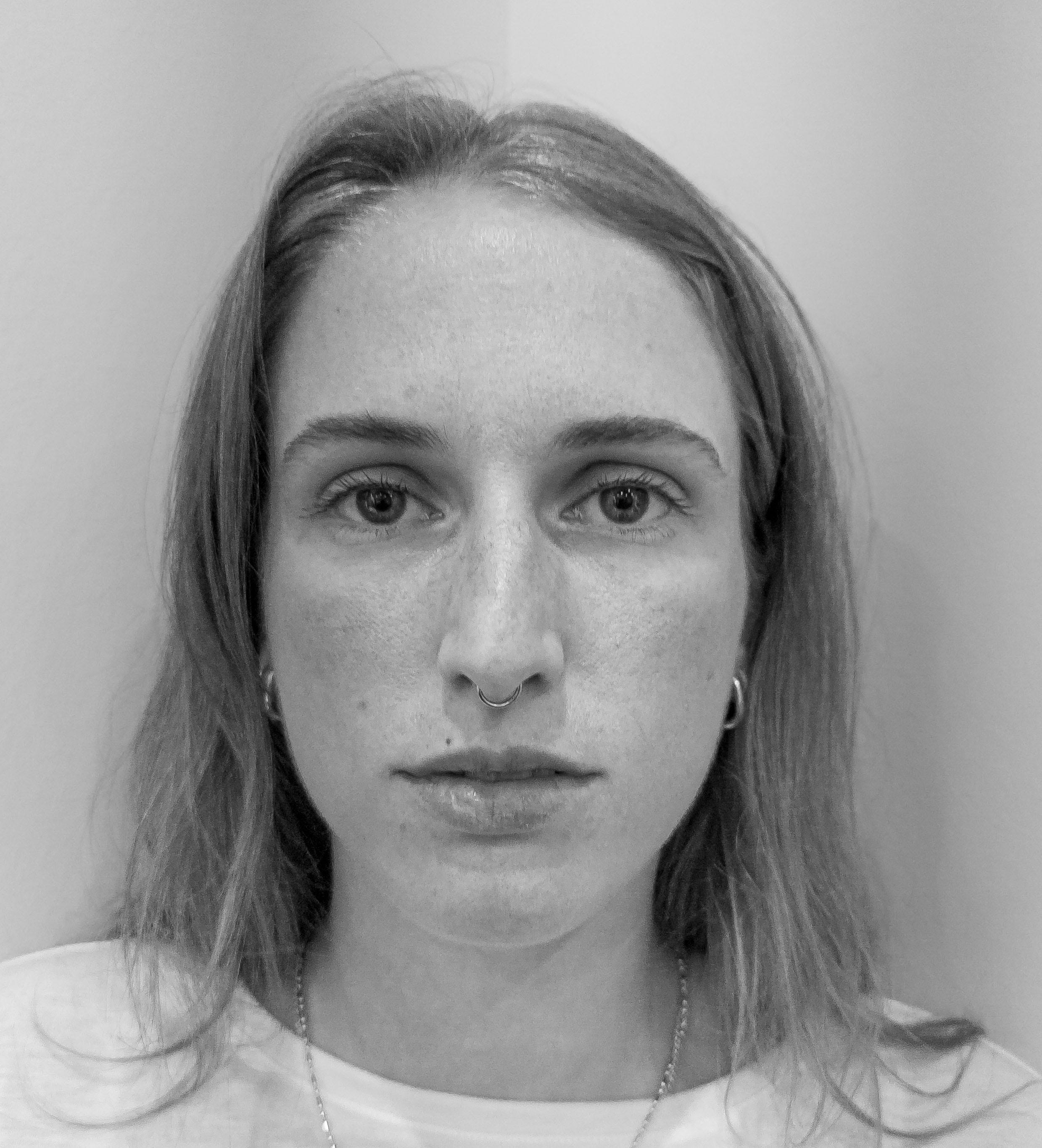
Some portraits arrive accompanied by biography. They tell us who the subject is, where they have come from, what they have endured, and why their appearance before the camera should matter. This portrait offers none of those interpretive supports. We are given no history to consult and no anecdote through which the face can be translated into a reassuring narrative. There is only the subject, the camera, and the sustained encounter created between the person in the photograph and the person standing before it. Far from diminishing the image, this absence of explanation strengthens it. The subject is not required to earn our attention through accomplishment, suffering, notoriety, or confession. Their presence is sufficient.
The composition is almost uncompromisingly direct. The face occupies the center of the frame, presented frontally and at close range. Hair descends along either side, loosely reinforcing the vertical structure of the image, while the eyes establish its strongest horizontal axis. The shoulders are only partially visible, and the background has been deprived of anything that might disclose place, circumstance, or social position. There is no setting to examine for clues, no surrounding object from which to manufacture a personality. Everything that might compete with the face has been reduced or removed.
Such frontality inevitably recalls the visual conventions of passports, institutional records, and identification photographs. Those images are designed to convert a person into something administratively legible. They isolate the face not to honor individuality but to make the individual recognizable to a system. This portrait borrows that visual grammar while refusing its underlying purpose. The subject may be centered, exposed, and plainly illuminated, but they are not rendered compliant. The photograph records their appearance without suggesting that appearance exhausts who they are. What initially resembles an act of classification becomes, through the subject’s self-possession, an assertion of irreducibility.
That transformation occurs most forcefully in the gaze. The subject looks directly into the camera without appearing to solicit approval from it. There is no smile offered as reassurance, no visible attempt at seduction, and no conspicuous dramatization of defiance. The eyes are attentive but not pleading. Their stillness produces a rare equality between subject and viewer. We are permitted to look, but the gaze is returned with equal force. The traditional imbalance of portraiture, in which one person observes while another is observed, is quietly disrupted. The subject does not remain passively inside the frame. They seem to occupy the space between image and viewer, making our own act of looking newly perceptible to us.
The expression resists the usual emotional categories. It is not cold, although it is restrained. It is not vulnerable, although nothing in the face has been armored against scrutiny. It is not confrontational, although it declines every familiar gesture of accommodation. The slightly parted lips prevent the countenance from becoming fixed or monumental. They introduce the faintest suggestion of an interrupted thought, a breath taken before speech, or a sentence consciously withheld. This small uncertainty animates the entire portrait. The subject appears neither frozen nor caught unaware, but momentarily suspended between inwardness and articulation.
This refusal of a readily consumable emotion is central to the photograph’s dignity. Contemporary portraiture often pressures its subjects toward legibility. Confidence must be emphatic, sadness must be visible, rebellion must announce itself, and beauty must be made immediately agreeable. Here, no single quality is allowed to dominate. Composure coexists with watchfulness; youth with gravity; openness with privacy. The face remains available to sight while the person retains the right not to be fully interpreted. Mystery, in this instance, is not an effect manufactured by shadow or theatrical pose. It is the natural consequence of accepting that another human being can never be made completely transparent.
The monochrome treatment intensifies this concentration. Background, skin, hair, and clothing inhabit a restrained spectrum of adjoining greys. The light is broad and nearly shadowless, revealing the surface of the face without turning that revelation into a spectacle. Pores, fine lines, subtle variations in texture, and small tonal irregularities remain present. These are not imperfections surviving despite the portrait; they are part of the evidence through which the portrait becomes credible. The image rejects the peculiar contemporary fiction that a face becomes more beautiful as it is made less human.
Yet the photograph is not clinically descriptive. Its softness prevents detail from becoming forensic, while the narrow tonal range gives the image an almost meditative quiet. The eyes and brows provide its darkest visual emphasis. Beneath them, the septum ring forms a smaller point of metallic punctuation, introducing a precise curve into the largely organic structure of the face. The earrings, necklace, and pale shirt remain secondary. They locate the subject within a contemporary language of self-presentation but never become substitutes for character.
It would be easy to treat the septum ring as a convenient generational symbol and to assign the subject an identity on its basis. The photograph wisely refuses that shortcut. Adornment can express taste, affiliation, pleasure, memory, or nothing more complicated than preference. It need not function as a declaration addressed to the viewer. By allowing the detail to remain visible without making it explanatory, the portrait respects the difference between self-fashioning and self-disclosure. We can see how the subject has chosen to appear, but we are not entitled to invent the reasons.
Within Beauty Knows No Limits, this portrait advances a definition of beauty grounded neither in conventional perfection nor in a compensatory celebration of difference. It does not plead for the inclusion of its subject within an existing hierarchy. To do so would leave that hierarchy intact, merely widening its admissions policy. Instead, the photograph questions the authority of any standard that separates worthy faces from unworthy ones. Beauty here is not a prize granted after measurement. It emerges through particularity: the exact spacing of the eyes, the natural asymmetries of the face, the texture of the skin, the line of the mouth, the fall of the hair, and the intelligence of the expression holding them together.
This is why the image can acknowledge physical beauty without reducing the subject to attractiveness. The face is undeniably arresting, but its power does not depend upon passive pleasantness. Beauty is joined to autonomy. The subject does not decorate the frame for our enjoyment; they determine the terms under which the encounter takes place. We may admire, but admiration does not confer ownership. We may study the face, but study does not become mastery. The photograph asks us to recognize beauty while relinquishing the habit of treating beauty as public property.
Its place within Faces of the Future is equally significant. The title of that series could easily encourage prediction. Faced with a young person, viewers may be tempted to search for evidence of what an entire generation will become. Every expression risks being converted into a social diagnosis, every ornament into a cultural trend, every silence into a political position. This portrait offers a necessary correction. No individual face can bear the weight of representing millions of lives, nor should youth be treated merely as raw material for older generations’ hopes and anxieties.
The future embodied here is not an abstraction, and it is not waiting obediently to inherit a world designed by others. It already possesses a gaze, an aesthetic, a private consciousness, and the ability to withhold assent. The subject’s composure suggests neither optimism nor despair. More importantly, the photograph does not demand either. It allows the future to remain unresolved because the person before us is unresolved, as every living person must be. Possibility is preserved not by projecting a destiny onto the subject but by declining to decide in advance who they will become.
Knowing nothing personal about the sitter ultimately protects the encounter from false intimacy. We cannot convert a fragment of biography into a key and congratulate ourselves for having unlocked the face. We must remain with what the photograph genuinely gives us: a young person meeting the camera without disguise, yet without surrender; a face illuminated but not explained; a presence that neither retreats from attention nor performs for it.
The achievement of the portrait lies in this balance. It is visually simple but not slight, intimate but not invasive, beautiful but never merely flattering. It grants the subject visibility while preserving interior freedom. In doing so, it expresses the shared ethical foundation of both series. Beauty has no legitimate boundary because human particularity cannot be standardized, and the future cannot be understood until we permit those who will inhabit it to appear as themselves.
The future, this photograph proposes, does not enter with fanfare. It is already present, looking directly back at us.
- Élodie Vasseur
Paris, France