

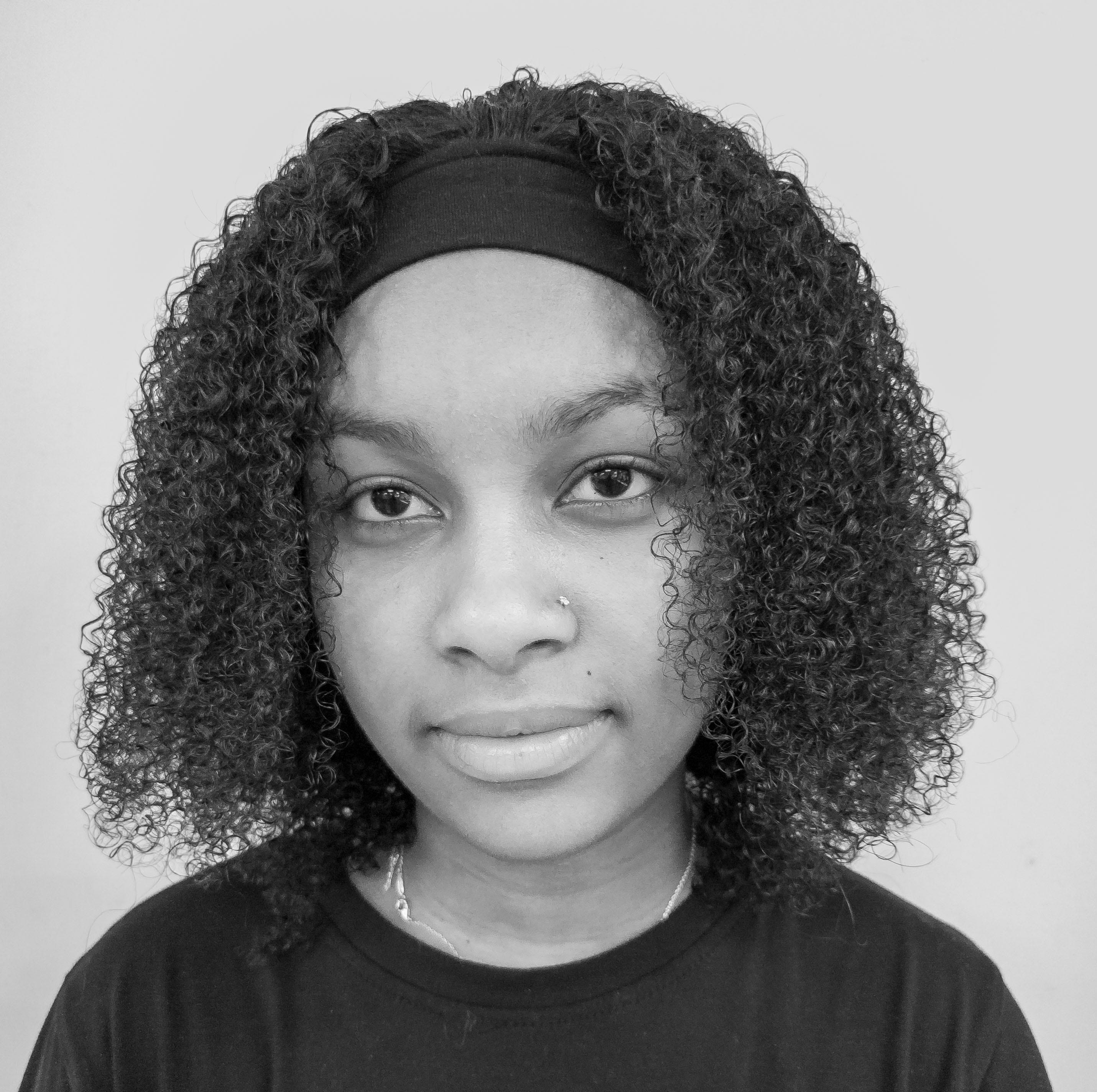
The frontal portrait is frequently mistaken for the simplest form of photography. It is, in fact, among the least forgiving. Once setting, gesture, anecdote, and elaborate costume have been removed, every remaining decision becomes exposed: the distance between camera and subject, the level of the lens, the distribution of light, the organization of the frame, and, above all, the character of the encounter between the person photographed and the person looking. This portrait accepts that severity. It places a young woman before us without spectacle or narrative apparatus and trusts that a face, properly regarded, is not an absence of information but an inexhaustible form of it.
She occupies the frame with striking compositional assurance. Her face is centered almost precisely, yet the image never acquires the inert neutrality of an identification photograph. The reason lies principally in the magnificent architecture of her hair. Its dense curls form a large, irregular oval around the more delicate oval of the face, establishing a portrait within the portrait. The dark headband creates a firm horizontal interval between forehead and hair, while the black shirt anchors the composition at its base. Between these two dark registers, the face appears suspended in light.
It would be easy to describe the hair merely as a halo, but that would sentimentalize what is formally far more interesting. It is not an ornamental border applied to the subject. It is active structure. Its profusion enlarges her presence while its countless deviations prevent the centered composition from becoming rigid. Individual curls advance toward the forehead, gather beside the cheeks, and escape the otherwise orderly perimeter. On one side, a loose spiral enters the facial field and comes close to the eye, introducing movement at precisely the point where symmetry might otherwise have become too complete. The portrait is balanced, but it is not domesticated.
That distinction is central to its beauty. Symmetry provides the image with repose, while asymmetry preserves the subject’s individuality. The small nose stud catches the light as a minute point of brilliance. A natural mark near the mouth punctuates the smoother tonal field of the lower face. A narrow section of necklace emerges briefly from the darkness of the shirt before disappearing again. None of these details is emphasized, yet each interrupts the possibility that the face might be reduced to an idealized diagram. They remind us that beauty does not arise from the elimination of irregularity. It often becomes perceptible through the exact arrangement of those qualities that no theoretical model could have prescribed.
The monochrome treatment is particularly effective. The skin has been brought into the high tonal registers, but not so far that it becomes blank or porcelain-like. Subtle transitions remain visible across the forehead, beneath the eyes, around the nose, and at the edges of the mouth. The face possesses an almost graphite quality, as though it had been patiently drawn rather than instantaneously recorded. Against the darker hair, headband, and clothing, these pale gradations acquire unusual clarity. The distinction between softness and definition is maintained with considerable care: the illumination is generous, but the subject has not been dissolved by it.
There is very little conventional shadow from which to manufacture mystery. Portraiture has often relied upon darkness to imply psychological depth, as though an obscured portion of the face must necessarily correspond to an obscured portion of the self. This photograph proposes something more intelligent. It understands that privacy does not depend upon concealment. Nearly everything the light can disclose is made available to us, yet the woman remains beyond possession. We can examine her features, register her expression, and return her gaze, but we cannot convert visibility into knowledge. The photograph allows her to be seen without pretending that being seen is equivalent to being fully known.
Her eyes establish the ethical and emotional center of the image. They meet the lens directly, but their directness contains neither theatrical defiance nor practiced submission. The brows and eyelids remain relaxed. There is attentiveness without alarm and confidence without display. The slight difference between the two eyes, intensified by the curls approaching one side of the face, gives the gaze its living quality. She is not staring through the camera toward some abstract distance. She appears to be looking at the person behind it and, by extension, at every subsequent viewer.
The mouth complicates that exchange. Its gentle upward movement suggests the beginning of a smile, but the expression has not been carried to the point of social performance. It offers warmth without reassurance. She does not seem to be smiling in order to make herself agreeable to the viewer, nor withholding a smile in order to project seriousness. Instead, the expression remains poised between states, and that interval gives the portrait much of its emotional intelligence. We encounter neither a fixed mood nor an easily consumed personality, but a moment in which several possibilities coexist.
This is why the image belongs so naturally within Beauty Knows No Limits. The series title might, in less careful hands, become a benign declaration that beauty can be found everywhere, a proposition that still leaves someone in authority deciding where “everywhere” begins and ends. This portrait makes a more consequential argument. It does not petition for the subject’s admission into a previously established category. It asks why the category should possess borders at all.
Her beauty is neither presented as remarkable because it is supposedly unexpected nor validated through resemblance to a narrow inherited ideal. It emerges from the total relationship among feature, expression, texture, proportion, self-possession, and photographic form. The camera does not inventory her face in search of evidence that she satisfies a standard. It attends to her as a complete and particular person. Beauty becomes not a verdict delivered upon her, but an experience produced in the encounter with her.
That difference carries special importance when the subject is a young Black woman. The histories of beauty, advertising, portraiture, and popular culture have too often treated Black women first as classifications and only afterward, if at all, as individuals. Yet it would be equally reductive to place upon this woman the burden of correcting those histories. She is not required to function as sociological evidence, a symbolic exception, or an emblem of collective virtue. The portrait acknowledges the cultural force of her appearance without allowing that force to exhaust her meaning. She is not here to demonstrate a thesis. The thesis must reorganize itself around the fact of her presence.
The monochrome rendering participates subtly in this refusal. Black and white does not erase racial difference, nor should it be praised for making the subject somehow “universal,” a word too often used when particularity has been made comfortable for the dominant gaze. Instead, monochrome concentrates attention upon tonal relationships while leaving identity intact. Her skin, hair, features, adornments, and expression remain unmistakably her own. Difference is neither exaggerated into spectacle nor softened into neutrality. It is permitted simply to exist.
The photograph is equally persuasive within Faces of the Future. Representations of the future frequently depend upon abstraction. We are shown technology, architecture, crowds, speed, or young people made to symbolize either hope or decline. Individual lives disappear beneath generational prophecy. Here, the future is approached at human scale. It is neither a machine nor a demographic forecast. It is a person looking back.
Importantly, the portrait does not ask this woman to illustrate optimism. Youth is too frequently burdened with that demand, just as it is alternately burdened with accusations of fragility, impatience, narcissism, or impending failure. Nothing in the image authorizes such simplifications. Her expression is open, but not naïve; composed, but not passive; self-aware, but not consumed by self-presentation. The photograph offers no biographical claims about her ambitions, experiences, or beliefs. What it gives us instead is something more fundamental: the unmistakable presence of a consciousness that cannot be reduced to our projections.
The future, in this formulation, is not waiting politely to inherit a world completed by others. It is already here, observing the world it has been given. The directness of her gaze subtly reverses the assumed direction of judgment. We may initially believe that we are assessing her appearance, her expression, or her place within the frame. Gradually, however, the relationship becomes reciprocal. Her calm attention returns the question to us. What standards have we brought to the act of looking? What expectations have we imposed upon beauty, youth, race, femininity, and the future itself? Which of those expectations belong to her, and which reveal only the limitations of the viewer?
The photographer’s restraint makes this reversal possible. There is no dramatic angle establishing dominance or vulnerability. The camera remains approximately at eye level, granting neither superiority nor diminishment. The close framing establishes intimacy without forcing familiarity. Even the nearly featureless background performs an important function. By removing environmental clues, it prevents the viewer from constructing a convenient story about class, occupation, taste, or circumstance. We are denied the usual shortcuts by which a setting can be mistaken for a biography.
Such removal carries a risk. A neutral background can sometimes isolate a person so completely that the result feels clinical or administrative. Here, the danger is overcome by the subject’s reciprocal engagement and by the vitality of the surrounding forms. The hair supplies movement, the eyes supply contact, and the restrained expression supplies duration. She does not appear extracted from the world. Rather, the world has been temporarily quieted so that she can be encountered without distraction.
The success of the portrait ultimately rests upon its understanding that attention is more valuable than explanation. It neither dramatizes the subject nor claims to reveal her essence. No photograph could honestly do so. Instead, it preserves the integrity of a particular meeting: one person before a camera, composed but not fixed, visible but not appropriated, receptive but not available for possession. The viewer leaves without a biography, yet not without having experienced an encounter.
In that encounter, the two series converge. Beauty is no longer a territory whose guarded border the subject has successfully crossed. The limitation exists not in beauty but in the habits of perception that attempt to contain it. The future is no longer an empty surface upon which the present may write its anxieties or consolations. It already possesses a face, an intelligence, and a gaze of its own.
This young woman does not ask the camera to make her beautiful, and she does not ask the viewer to imagine her as the future. The photograph succeeds because it recognizes that neither condition requires invention. Beauty is already present. The future is already looking back.
- Élodie Vasseur
Paris, France