

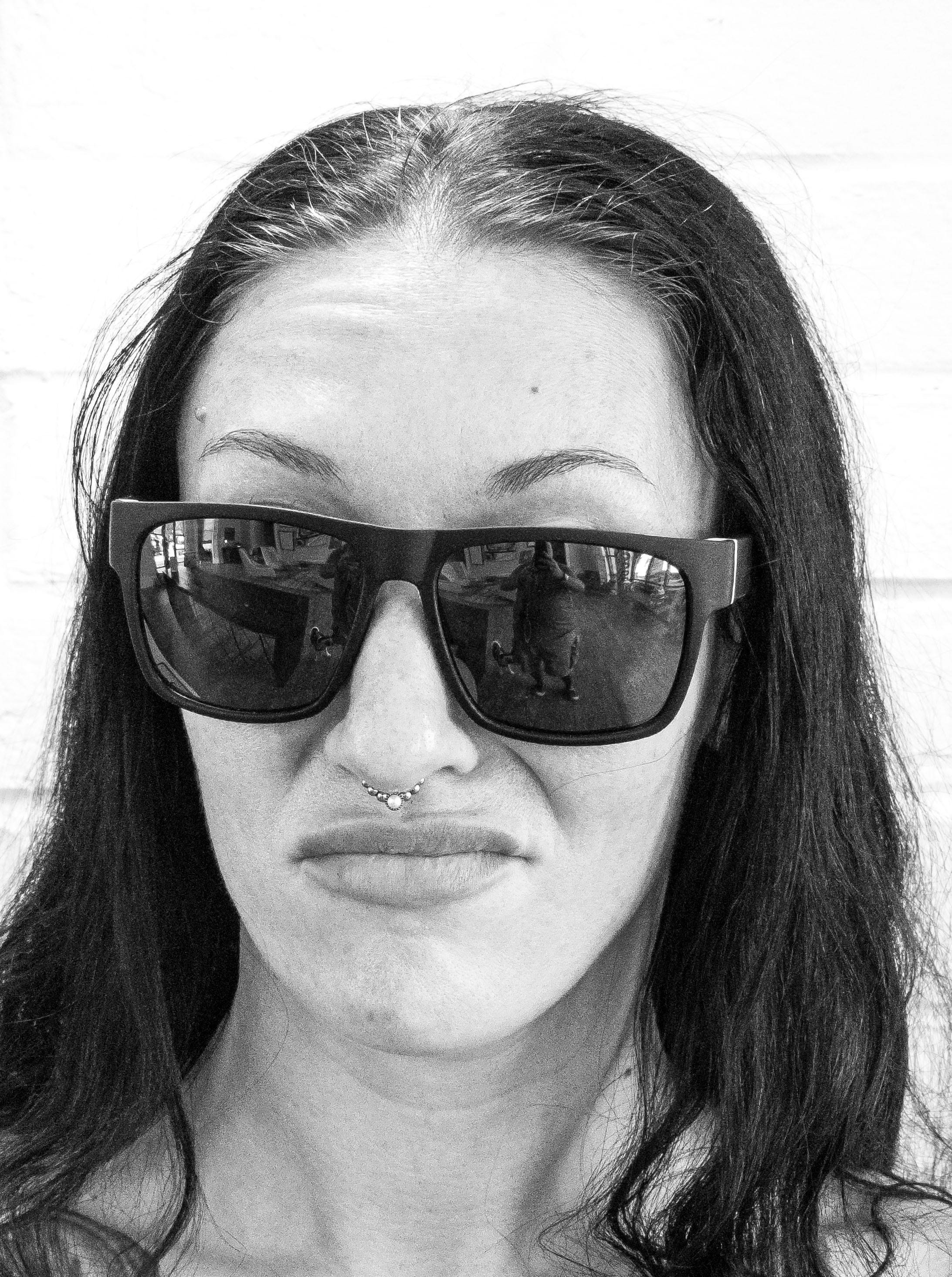
Portraiture has long depended upon a tacit exchange. The subject permits the camera to examine a face, and the resulting photograph allows the spectator to imagine that such examination has produced knowledge. Eyes are especially important to this convention. We have been taught to regard them as confirmation that an encounter has occurred, as though visibility granted access and looking constituted understanding. This photograph interrupts that exchange at precisely its most familiar point. The face is placed before us with extraordinary directness, yet the eyes remain entirely unavailable. What initially appears to be a simple obstruction gradually becomes the image’s governing intelligence.
There is no physical distance into which the subject might retreat. The head fills nearly the whole vertical frame, the hair presses against both sides, and the lower edge cuts across the shoulders before the body can establish any independent presence. The face is not situated within a descriptive environment; it is the environment. A pale, nearly emptied background intensifies this effect, leaving no anecdotal detail to divert attention. We are brought close enough to register the fine variations of the skin, the individual strands of hair, the line of the lips and the delicate construction of the septum ring. Yet proximity does not yield possession. The closer the photograph brings us, the more emphatically it demonstrates that nearness and intimacy are not interchangeable.
The sunglasses establish this distinction. Their scale is considerable, covering the central portion of the face and forming a broad dark interval between the exposed forehead and the lower features. They are not a minor accessory within the composition. They are its architecture. The heavy upper line stretches almost uninterruptedly from one side of the face to the other, while the squared lenses impose a severe geometry upon the softer contours surrounding them. Against the organic movement of the hair, the subtle irregularities of the skin and the rounded form of the cheeks, the frames appear deliberate and constructed. They divide the face without fragmenting it, producing two different conditions of visibility within a single countenance.
Above them, the eyebrows remain visible, their slight asymmetries preventing the composition from becoming rigidly diagrammatic. Below them, the nose, mouth and chin are presented without theatrical emphasis. The lips are closed but not compressed; the expression is composed without becoming declarative. It neither solicits approval nor manufactures aloofness for the camera. This matters because a neutral face, particularly one habitually expected to make itself agreeable through a smile, is too often assigned an attitude it has not expressed. The photograph avoids that coercion. It permits composure to remain composure. We are not supplied with an emotional caption, and the image refuses to convert stillness into a story merely to satisfy our appetite for explanation.
Ordinarily, the eyes would be asked to resolve this ambiguity. We might search them for warmth, reticence, confidence, fatigue, amusement or any of the other psychological conclusions that portrait viewers readily produce from the smallest visual evidence. Here that familiar route is closed. The dark lenses prevent the spectator from completing the face according to those conventions. Yet the eyes do not feel absent. Their unseen position exerts a constant pressure upon the picture. We know that a gaze may be directed toward the camera, but we cannot inspect it in return. The relationship is therefore unequal in an unexpected direction: the subject may see the photographer, while neither photographer nor later spectator is allowed the corresponding assurance of being able to see back.
The lenses do more than deny entry. They reflect. Within their dark surfaces appears a compressed version of the space facing the subject, including the figure responsible for making the photograph. The portrait thus contains a second, much smaller image: not another face in any conventional sense, but the scene of its own creation. A room that has been almost completely excluded by the pale background returns as a shadowed interior. The camera, normally treated as an invisible intermediary, leaves evidence of its position. The photographer, who would ordinarily control the frame while remaining outside it, is quietly placed inside the subject’s glasses.
This reversal alters the ethical structure of the photograph. The subject is monumental, occupying nearly all the available space, while the reflected maker is reduced to a dark, miniature presence. The one who looks is also seen looking. It would be excessive to call this an exposure, since the reflection carries no accusatory force, but it does remove the fiction that portraiture is an unobserved act performed by a disembodied eye. Someone stood before this person. Someone raised a camera. Someone chose the instant and the distance. The lenses retain that encounter as a faint visual record, making the conditions of authorship inseparable from the face being photographed.
For this reason, the sunglasses cannot be understood merely as a means of hiding. They produce a more complex form of exchange. The subject withholds the feature to which portraiture traditionally assigns the greatest emotional authority, while simultaneously returning the image of the person requesting that access. What might have functioned as a barrier becomes a reflective threshold. The spectator approaches the face expecting disclosure and instead meets the apparatus of disclosure itself. We are reminded that every portrait is relational, even when its formal simplicity encourages us to forget the person behind the camera.
The small septum ring provides an exact counterweight to the glasses. Where the frames are broad, dark and rectilinear, the jewelry is fine, bright and curved. It occupies the central axis of the face, directly beneath the bridge, and joins the composition’s upper and lower regions without diminishing their tension. Its tiny beads catch the light as a sequence of pale points, bringing delicacy into an image otherwise dominated by strong contrasts and emphatic shapes. It is a mark of self-presentation, but the photograph does not enlist it as shorthand for temperament, affiliation or rebellion. To do so would replace observation with stereotype. Here it remains what it visibly is: an intentional detail whose significance belongs first to the person wearing it.
Monochrome gives these relationships unusual precision. Color might have encouraged attention toward complexion, cosmetics, hair tone, clothing or the commercial associations of the glasses. Black and white concentrates instead upon density, contour and reflected light. The hair forms two dark masses that contain the brighter oval of the face. The glasses deepen that tonal structure across the center, while the septum ring punctuates it. At the same time, the conversion does not make the skin marble-smooth or abstract. Its surface remains various and specific. The forehead, cheeks and area around the mouth retain the minute evidence of an actual face under actual light. Beauty is not achieved by evacuating the subject’s physical particularity.
This is where the photograph becomes especially consequential within Beauty Knows No Limits. The series title could easily invite images that simply enlarge the category of conventional attractiveness while leaving its underlying demands intact. This portrait does something more exacting. It asks whether beauty must be accompanied by availability. Must a face offer its eyes, disclose an emotion, soften itself through a smile or provide the spectator with some reassuring account of who the person is? Here the answer is no. The image does not argue for beauty despite concealment, as though the sunglasses were an impediment that the remaining features must overcome. Concealment participates in the beauty of the picture because it gives the face a form that cannot be consumed at a glance.
The result is neither an idealization nor a celebration of mystery for its own sake. Mystery can become another decorative cliché, particularly when imposed upon a subject who has supplied no narrative. What this photograph preserves is something more fundamental: the distinction between being visible and being fully interpretable. The face is lucid as a visual fact. Its proportions, textures, adornment and bearing are available to careful attention. What remains inaccessible is the imagined final answer that viewers often expect a portrait to provide. The image allows recognition without pretending to produce completion.
Faces of the Future introduces a different temptation, that of making an individual face stand for an entire generation. This photograph resists that burden as firmly as it resists compulsory emotional disclosure. The subject need not symbolize an age group, a cultural tendency or a generalized future in order to belong within the series. The future proposed here is not a prediction written upon someone’s appearance. It lies instead in a more mature conception of portraiture, one that acknowledges how thoroughly contemporary life is mediated by images while still respecting the right of a person not to become wholly legible through them.
The reflective glasses are crucial to that conception. They register both sides of the photographic meeting: the person being pictured and the person producing the picture. They reveal that an image is not taken from a passive surface but made across a distance between two presences. That distance remains even in extreme close-up. Indeed, the photograph’s power arises from maintaining it. The camera comes near without claiming to have crossed the final interval between appearance and interior life.
What remains is a face of exceptional visual force, held between revelation and refusal without being reduced to either. The broad frames, the minute ornament, the closed lips, the dark hair and the nearly weightless background combine into a composition at once austere and intensely particular. We see more than we first expect, including the act of seeing itself, but we are prevented from confusing that abundance with total knowledge. The eyes are hidden, yet the portrait is not incomplete. Instead, it reveals the incompleteness of our usual way of looking.
- Élodie Vasseur
Paris, France