

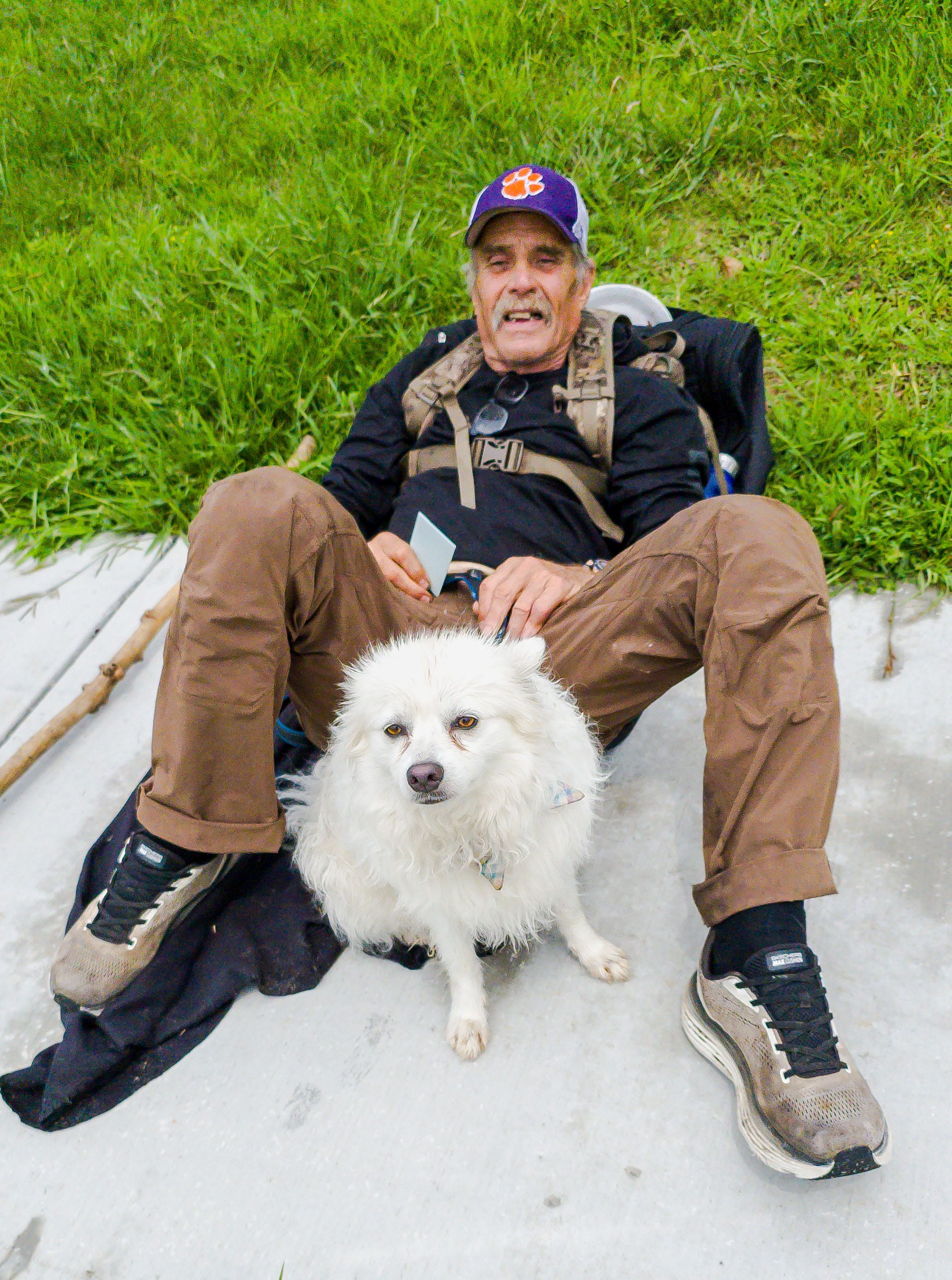
I am beginning ‘Homeless in America’ with a man who goes by Cowboy and a dog whose name is Amy. I use their names immediately because names are among our first defenses against abstraction. The phrase “the homeless” may be grammatically convenient, but it is morally dangerous. It takes millions of distinct human lives, strips them of history and individuality, and compresses them into a category that the rest of us can discuss without ever having to encounter a person.
Cowboy is a person. Amy is a sentient being. Homelessness is a condition imposed upon their lives; it is not the totality of who they are.
Cowboy sits on a sloping expanse of concrete, with Amy positioned securely between his legs. Behind them is green grass, thick with the ordinary abundance of spring or summer. It is a setting many of us might cross without a second thought. For Cowboy and Amy, however, public space is not merely something to pass through on the way home. When one has no home, the distinctions between public and private, between resting and loitering, between existing and being regarded as a nuisance, become brutally consequential.
The photograph contains visible wear, fatigue and material insecurity. What it does not contain is a lesser man or a lesser life.
I do not know every circumstance that brought Cowboy to this place, and I will not invent a biography for him merely to make his suffering more digestible. He should not have to satisfy some public test of innocence before we recognize his humanity. America has developed the grotesque habit of demanding a confession from the poor before extending even the most reluctant measure of compassion. What happened? Did he lose his job? Is he ill? Did he make a mistake? Does he drink? Did he fail to plan? Is he sufficiently remorseful? We ask such questions as though shelter were a prize reserved for those who can prove themselves morally unblemished.
The wealthy are permitted mistakes, eccentricities, addictions, bankruptcies and spectacular failures. Their errors are called risk, misfortune or reinvention. When a poor person falters, however, the failure is treated as revelation. It supposedly exposes defective character and is offered as justification for whatever suffering follows.
Even if Cowboy has made mistakes, he has done nothing more extraordinary than join the rest of the human race. Error does not nullify personhood. Bad judgment is not a deed by which someone signs away the right to sleep behind a locked door, wash in privacy, keep his belongings safe and wake without wondering whether he will be ordered to move again. Housing should not depend upon our ability to present ourselves as faultless before an imaginary tribunal.
This is why homelessness in America is not simply unfortunate. It is scandalous.
We live in a country of almost incomprehensible wealth, a country that repeatedly describes itself as the greatest on earth. Yet greatness is not established through repetition. It is not measured solely by the size of an economy, the reach of an arsenal, the height of a skyline or the fortunes accumulated by a handful of individuals. A society reveals its character much lower to the ground. It reveals itself in what happens when a person’s money runs out, when rent exceeds income, when a body becomes sick, when work disappears, when a family fractures or when one piece of bad luck is followed by another.
By that measure, the figure of Cowboy seated on concrete is not an indictment of Cowboy. It is an indictment of us.
Homelessness amid abundance is not a natural disaster. It is not weather. It is not an inexplicable force that descended upon our cities and towns from somewhere beyond human control. It is the physical consequence of choices, priorities and repeated refusals. We have arranged shelter as a commodity distributed according to purchasing power and then expressed surprise when people without sufficient purchasing power have nowhere private in which to exist. We tolerate the production of immense private fortunes while treating the provision of basic security as impossibly expensive. The resources exist. What is absent is the determination to use them for people whose suffering carries little political cost.
Instead of confronting that failure, we often concentrate upon making homelessness less visible. We move people along. We remove their belongings. We make places inhospitable to sitting or sleeping. We rename displacement as cleanliness, order, safety or revitalization. The person remains homeless, but the housed population is temporarily spared the discomfort of seeing him.
That discomfort matters because it reveals something we would prefer not to know about ourselves. Cowboy disturbs the national mythology. His presence contradicts the promise that diligence is always rewarded, that misfortune is temporary, and that those who fall will be caught by some functioning system of public care. It is easier to regard him as the author of his condition than to acknowledge how quickly a human life can be pushed outside the boundaries of security, and how thoroughly our institutions can abandon someone once he gets there.
Amy matters in this photograph in her own right. She is not an accessory, a prop or a sentimental device included to make Cowboy more sympathetic. She is a living creature whose security is inseparable from his. She experiences hunger, cold, fatigue, fear, comfort and attachment. She depends upon him, and he is plainly not alone while she is beside him. In a life stripped of so many conventional forms of stability, their relationship possesses a reality that no bureaucratic classification can adequately describe.
We should be wary of romanticizing that bond. Love does not make exposure to the elements harmless, nor does companionship eliminate hunger or danger. But neither should any proposed act of assistance treat Amy as disposable baggage. A response that fails to recognize the relationship between them fails to recognize either of them fully. Sometimes, when nearly every material structure associated with home has disappeared, another being becomes the remaining experience of home.
This photograph does not ask us to pity Cowboy. Pity is too easy. Pity looks downward, experiences a brief emotion and then continues on its way. Recognition is more demanding because it places Cowboy upon the same moral plane as the viewer. It asks us to understand that his need for safety is not different in kind from our own. He is not required to perform shame, gratitude or picturesque despair for us. He is not here to reassure us that we are compassionate people because we paused to look.
Nor did I photograph Cowboy and Amy to turn homelessness into an aesthetic or to display my own conscience. There is an unavoidable danger whenever another person’s hardship enters a camera frame. The image can call attention to someone who has been ignored, but it can also consume his circumstances as visual material and leave him exactly where he was. A photograph cannot house Cowboy. It cannot guarantee food, medical care, security or a future. What it can do is remove one of society’s most convenient excuses: that he was unseen.
Once we have seen him, the moral burden changes hands.
Cowboy and Amy are not the scandal in this picture. Their existence requires no defense. The scandal is the precarity in which they have been forced to live, surrounded by a nation capable of extraordinary achievements yet unwilling to guarantee the most elementary conditions of dignity. The scandal is our familiarity with this sight. We have encountered people sleeping in doorways, beneath bridges, in vehicles, in tents and on concrete so often that another person’s emergency has become part of the scenery.
That acceptance is a moral failure. No society should become comfortable with human beings having nowhere safe to exist. No amount of patriotic language can conceal the contradiction of proclaiming national greatness while people live without shelter in plain view. We cannot credibly call ourselves civilized while treating survival as misconduct and poverty as evidence of guilt.
His name is Cowboy.
Her name is Amy.
They are here. Their lives are not abstractions, cautionary tales or interruptions in someone else’s landscape. They are lives of inherent value being lived now, in the same country and beneath the same sky as ours.
The burden of explanation does not belong to them.
It belongs to us.
- Will Hazlitt, R9 Media Photo Collective