

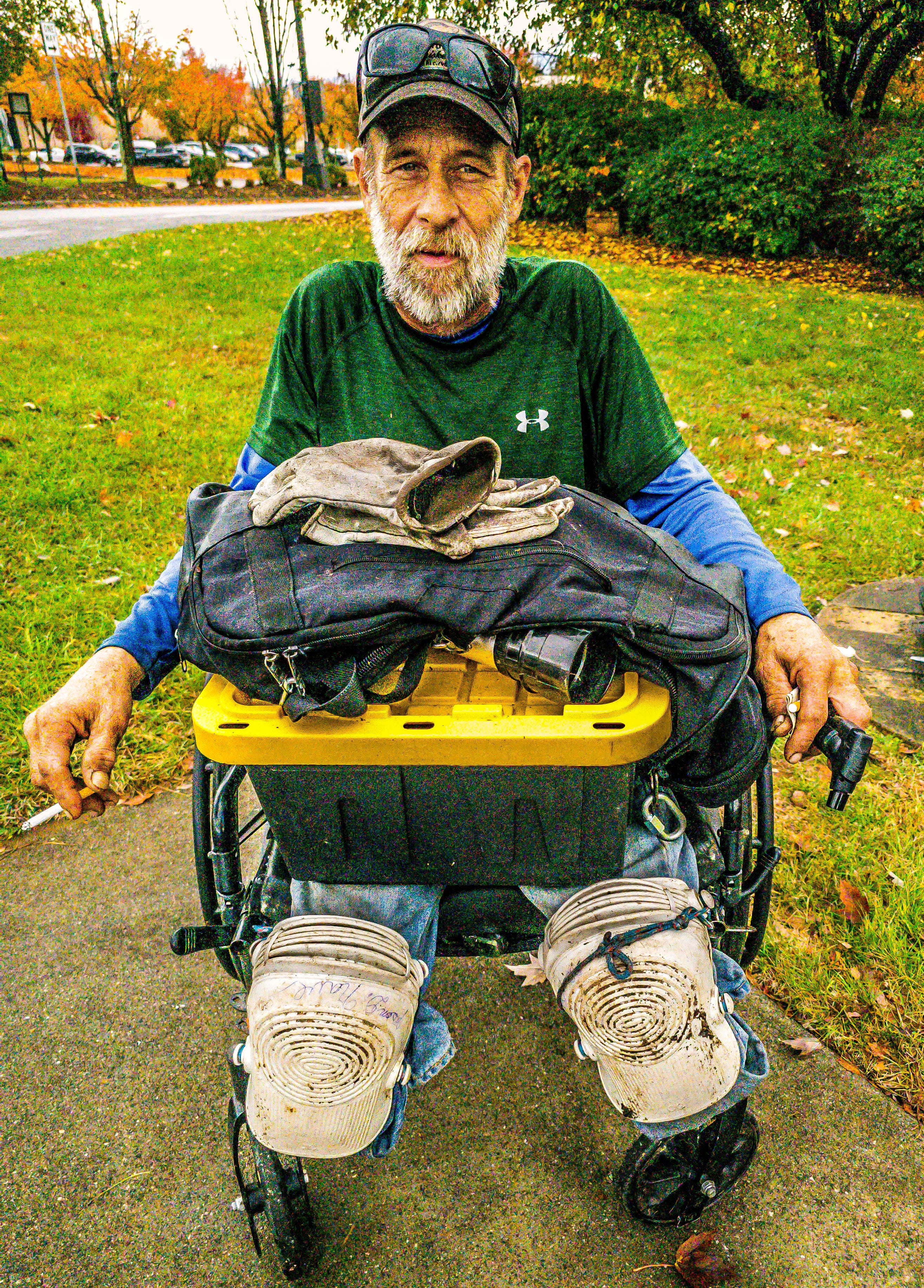
The man in this photograph is a double amputee living without a secure home. I keep returning to the knee pads: their pale, scuffed shells, their straps, the way they occupy the lower part of the frame. Above them, gloves rest on a black bag laid across the yellow lid of a storage box. These objects make protection visible in small, practical forms. His circumstances ask a larger question about the care available to a person whose daily life must accommodate both disability and homelessness.
His face rises above the belongings gathered in front of him. The cap shades his forehead; glasses rest across its crown. His hands extend to either side of the box and bag. We encounter him through an arrangement of objects that occupies much of the photograph, while his eyes remain directed towards the camera. I am conscious of how readily attention can settle on the equipment. The man looking back at us has a life extending far beyond what it allows us to see.
His amputations make the question of suitable housing especially concrete. A place to live must be somewhere he can enter, move through, and use safely. Access to a bathroom, space to manage equipment, and the ability to reach the things needed throughout a day are part of what makes accommodation usable. His particular requirements need to be established with him. An offer of somewhere indoors would remain inadequate if its physical arrangement prevented him from living there safely. When I say that he needs a home, I mean a place that works for the person who will inhabit it.
I find it indefensible that someone managing the practical consequences of amputation should also be left without that security. Homelessness places ordinary necessities under uncertain conditions. Where to wash, where to rest, where to keep belongings, and how to get between the places where help is available all become matters requiring repeated attention. A physical environment that is difficult to use adds further demands. Those difficulties deserve to be addressed in the provision of help, through a response shaped around the person receiving it.
The protective equipment before him brings me back to the limits of an individual solution. A glove can cover a hand. A pad can soften contact with a hard surface. A container can keep possessions together. Each addresses a particular problem. A secure home makes a more sustained kind of care possible: somewhere to wash and change, to keep clothing dry, to arrange necessary equipment, and to rest with some control over the conditions around the body. It provides a dependable setting for needs that return every day.
I think about how much freedom lies in being able to put something down. A bag can be emptied. Clothing can be hung up. An object can wait for repair. The things needed tomorrow can be placed somewhere reachable and expected to remain there. These arrangements are easily overlooked when they form the background of a settled life. In this photograph, so much has been gathered immediately against him. I want him to have room to arrange his belongings according to what makes his life comfortable and manageable, with somewhere secure for them to remain.
The setting makes the picture particularly difficult for me. The grass is green, the trees carry autumn colour, and a road passes through the background. It is an ordinary outdoor scene with considerable visual appeal. The yellow lid stands out against the blue sleeves and green shirt; the pale knee pads draw the eye into the lower frame. These relationships help the photograph hold our attention. His circumstances require that attention to extend into questions about how he can live, move, and rest after the photographed moment has passed.
A photograph fixes the leaves in place. The person continues into the next part of the day. His needs persist after the light changes and a reader moves to something else. The image cannot tell me where he will go or what assistance may be available to him. It does make me think about the hours for which a photograph has no room. I want our response to homelessness to last into those hours, when interest in an image has passed and the person still needs somewhere secure to be.
I am presenting this portrait as Anonymous. That is a limit on the information published here. His life remains as particular as the lines around his eyes or the marks on the equipment before him. Knowing that he is a double amputee gives us relevant information about his circumstances; it leaves much of his experience, his preferences, and his relationships beyond our knowledge. He should be able to explain what he needs while retaining authority over how much of his life he makes available to other people. Assistance ought to leave room for that privacy and choice.
I find the amount of improvisation involved in homelessness deeply troubling. A practical solution to one immediate difficulty can make the next several hours more manageable. People devise ways to protect possessions, find support, and arrange what they have. Those efforts can attract admiration because they show resourcefulness. I want that admiration to lead us to examine the circumstances requiring so much effort. How much uncertainty do we become willing to leave with another person because he has found a way to manage part of it?
Immediate assistance has value, and I would never dismiss something that makes a person’s day less difficult. But I want the standard of adequacy to extend beyond the next interruption of need. For this man, that means secure housing he can reach and use, with support responsive to his actual circumstances. Those offering help need to follow through on the practical arrangements. Leaving those questions for him to resolve repeatedly is a failure of our responsibility to one another.
That is what I ask readers to consider when they look at this man. The protection visible in the photograph is specific and limited; his need for safety extends across a whole life. I want him to have somewhere the gloves can be set down, the equipment placed within reach, and the day allowed to end. His safety should extend beyond what he can fasten to his body or balance in front of it.
- Will Hazlitt, R9 Media Photo Collective