

Homeless in America, No. 4: Otis
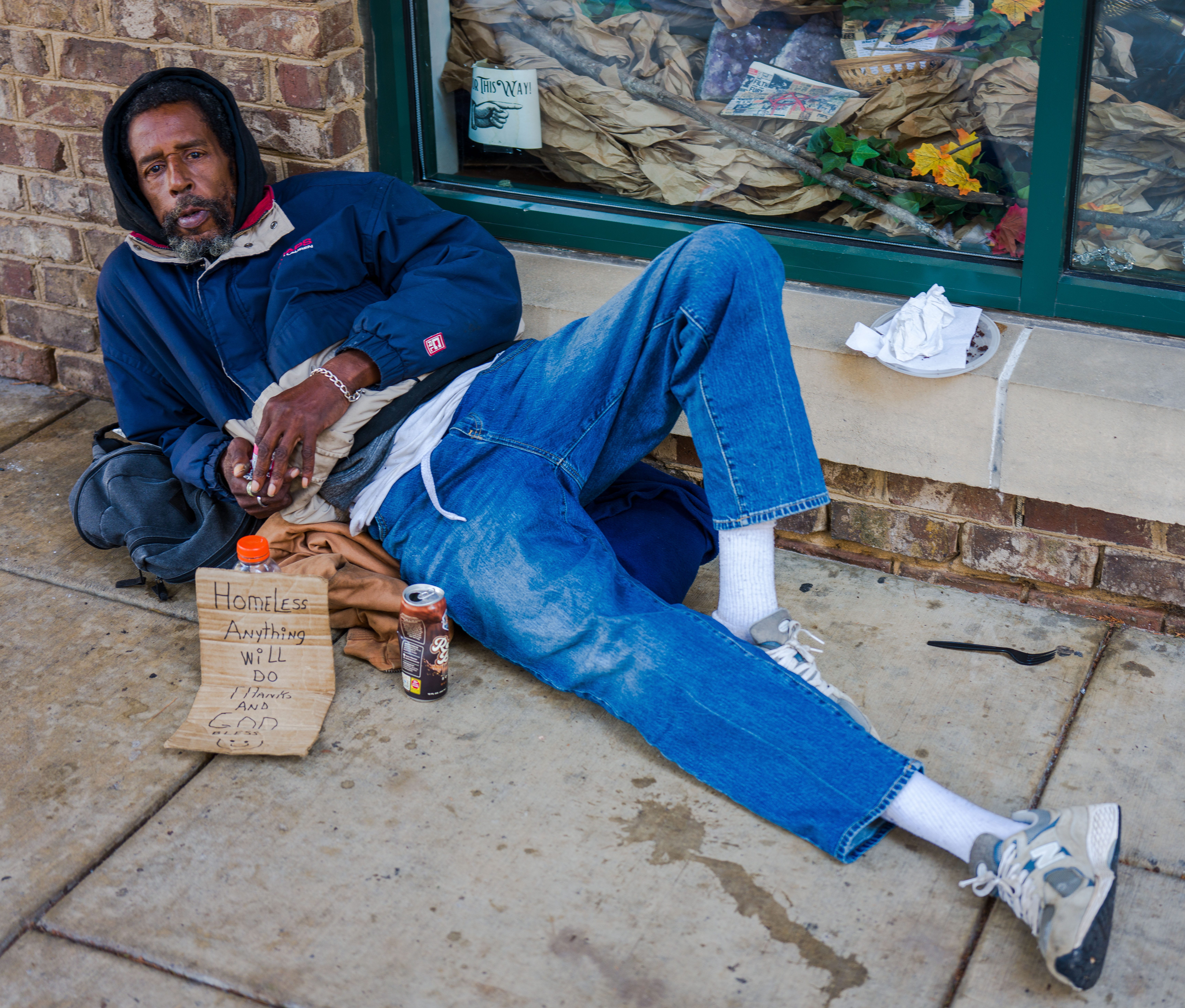
His name is Otis. He reclines against the base of a shop window, one knee raised and the other leg extending across the pavement. The blue of his jacket and jeans carries the eye through the photograph to his face. He looks directly into the camera. Beside him, a cardboard sign reads, “Anything will do.”
I find those words difficult to pass over. They leave the offer entirely with whoever reads them. A passer-by can decide whether to stop, what to give, and how long to remain. The sign makes its appeal within that unequal arrangement. The person asking has a need; the person being asked has the freedom to continue walking.
A meal or a few dollars can make a considerable difference to the next several hours. I value that help. I am also concerned with what happens when those hours end. Food and shelter remain daily necessities. An immediate act of kindness leaves the larger question of dependable support before us.
The modest scale of a request can make the scale of the deprivation easier to miss. “Anything will do” asks very little of the reader. We should take care with how readily we accept so low a threshold on another person’s behalf.
Otis occupies the photograph with a presence that exceeds the little sign beside him. He should be able to count on a home, regular meals, and some certainty about tomorrow. The measure of an adequate response is what would allow him to live securely.
Homeless in America, No. 5 (anonymous)
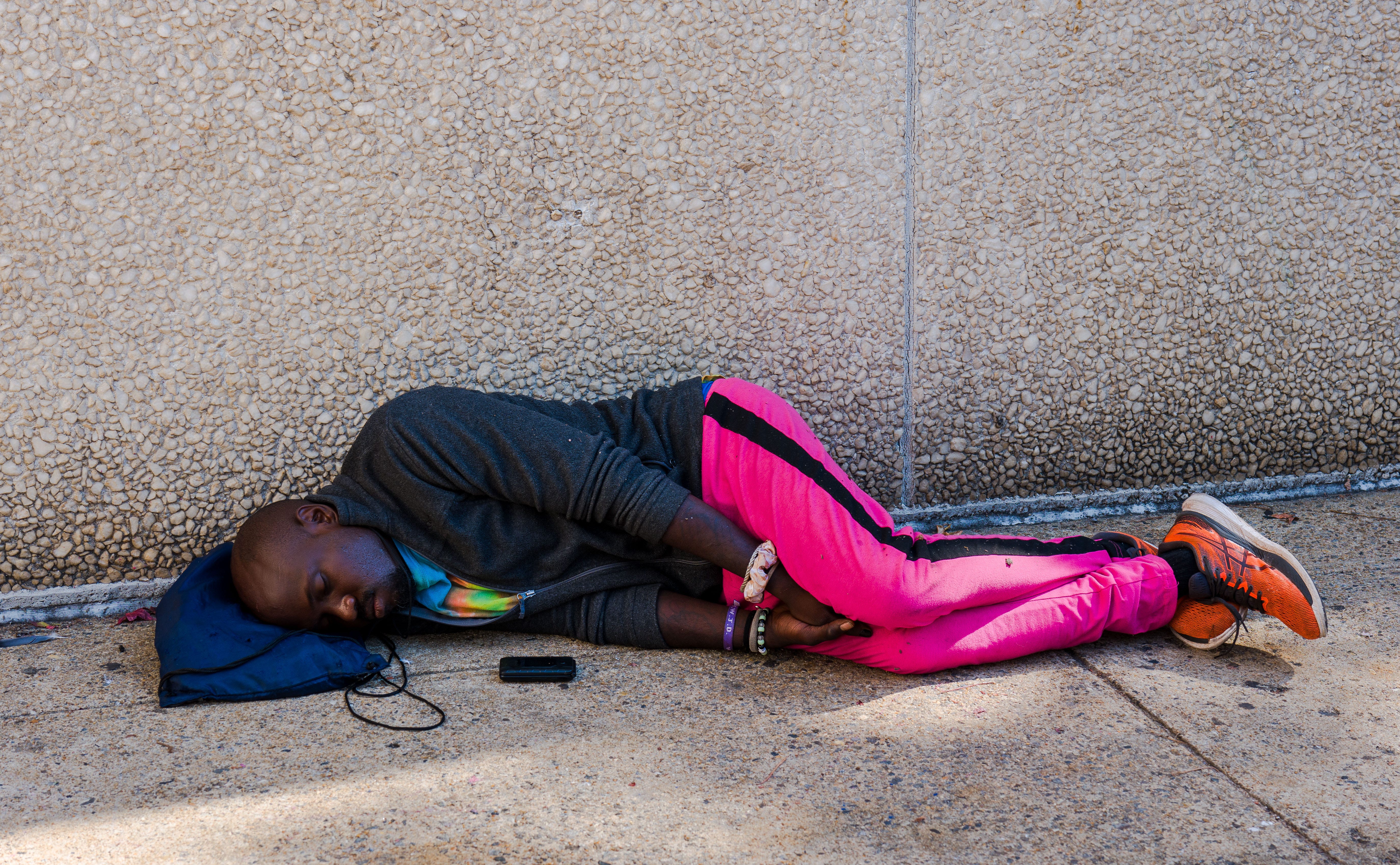
The pink trousers and orange shoes catch the eye first. Then there is the curve of the body against the pale, rough wall: knees drawn up, hands close together, eyes closed. A blue bag supports his head. A phone lies on the pavement within reach.
The wall fills much of the photograph. Beneath it, he has arranged himself in the narrow space where a person can lie down. The bag serves as a pillow; the paving supports everything else. Such small accommodations reveal how much the simplest bodily need can require when there is nowhere suitable to attend to it.
I think here about the need to stop. We all reach a point at which continuing becomes difficult and rest takes precedence over whatever else the day requires. Sleep asks us to relinquish our watchfulness. Somewhere secure, we can surrender to that need with a reasonable expectation of being left undisturbed.
On a pavement, that expectation is harder to sustain. Other people retain access to the space around the resting body. Footsteps, conversation, weather, and the movement of an ordinary day continue within its immediate surroundings. Even being still takes place on terms a person has little power to set.
A bed, a protected place, and enough uninterrupted time are among the things housing makes possible. Their absence reaches into the hours when a person has the least capacity to manage it.
I want our concern for homelessness to extend into those hours. A place to sleep in safety belongs among the basic things we owe one another.
Homeless in America, No. 6 (anonymous)
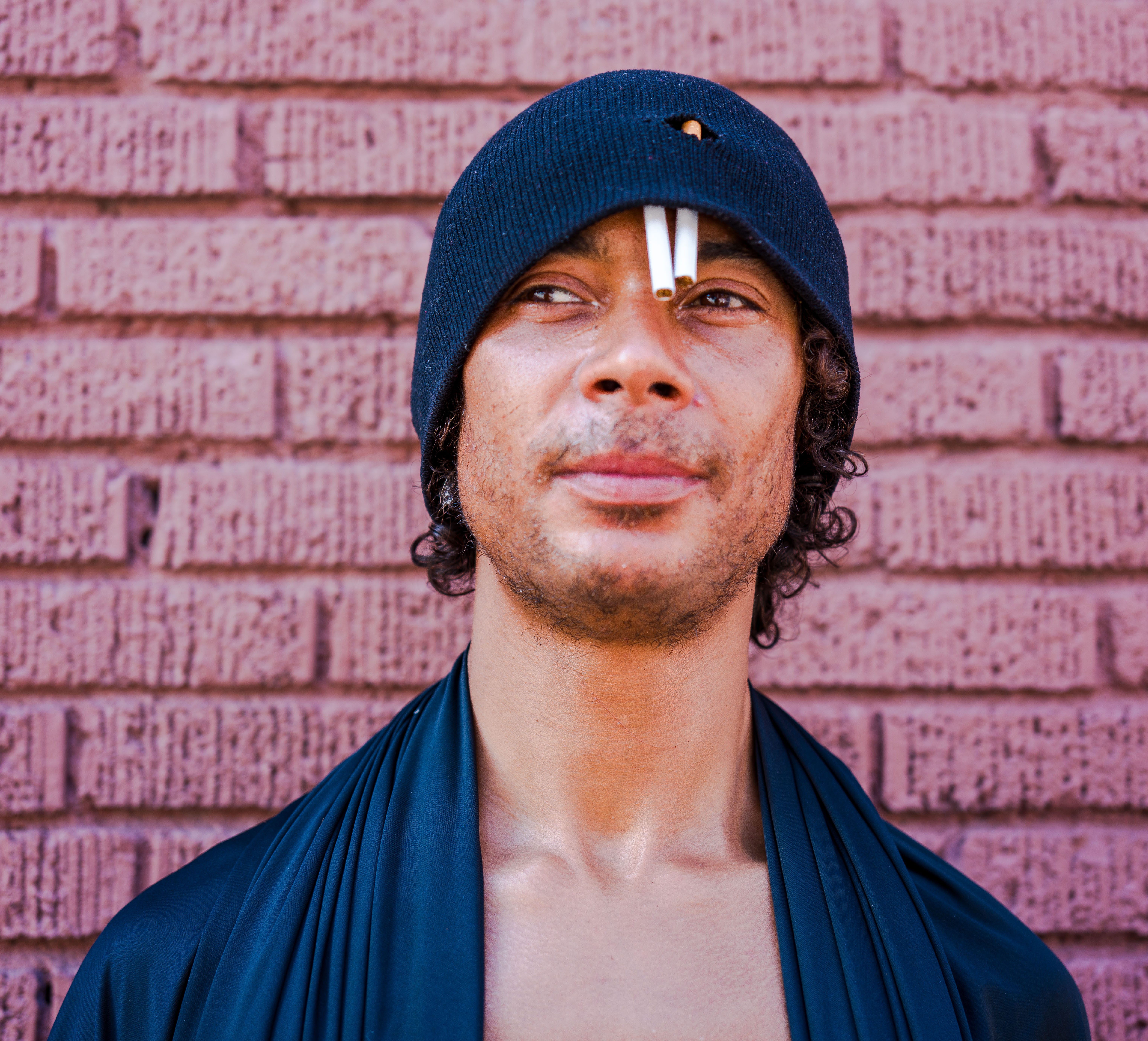
His name is withheld at his request. A dark knitted cap frames his face, with two cigarettes tucked beneath its edge. His eyes turn slightly to one side. There is a faint lift at the corners of his mouth. Behind him, the brickwork supplies a steady pattern against the loose dark fabric around his shoulders.
The closeness of the portrait gives these details room. His cap doubles as a place to keep the cigarettes. The direction of his gaze takes his attention beyond the camera. I am drawn to the sense that something continues outside this exchange, beyond what a viewer has been allowed to see.
A series about homelessness needs room for such a portrait. The expectation of visible suffering can become another restriction placed on people already living with considerable deprivation. An expression of ease, a moment of humour, or an interest in one’s appearance can be seized upon as evidence that the need has been overstated. That expectation makes a person’s face answerable to somebody else’s idea of hardship.
I want the people in these photographs to have the full range of expression that I take for granted in myself. A person may be sociable, reserved, distracted, amused, or simply occupied with something the photographer cannot know. The need for somewhere secure to live persists through all of it.
His decision to keep his name private matters within that relationship. It sets a limit on what he wishes to make available. I respect that limit. Looking closely brings an obligation to accept that some things remain his to decide.
He can turn his attention elsewhere. Our concern for his circumstances should be able to survive the moment when he looks away.
Homeless in America, No. 7 (anonymous)
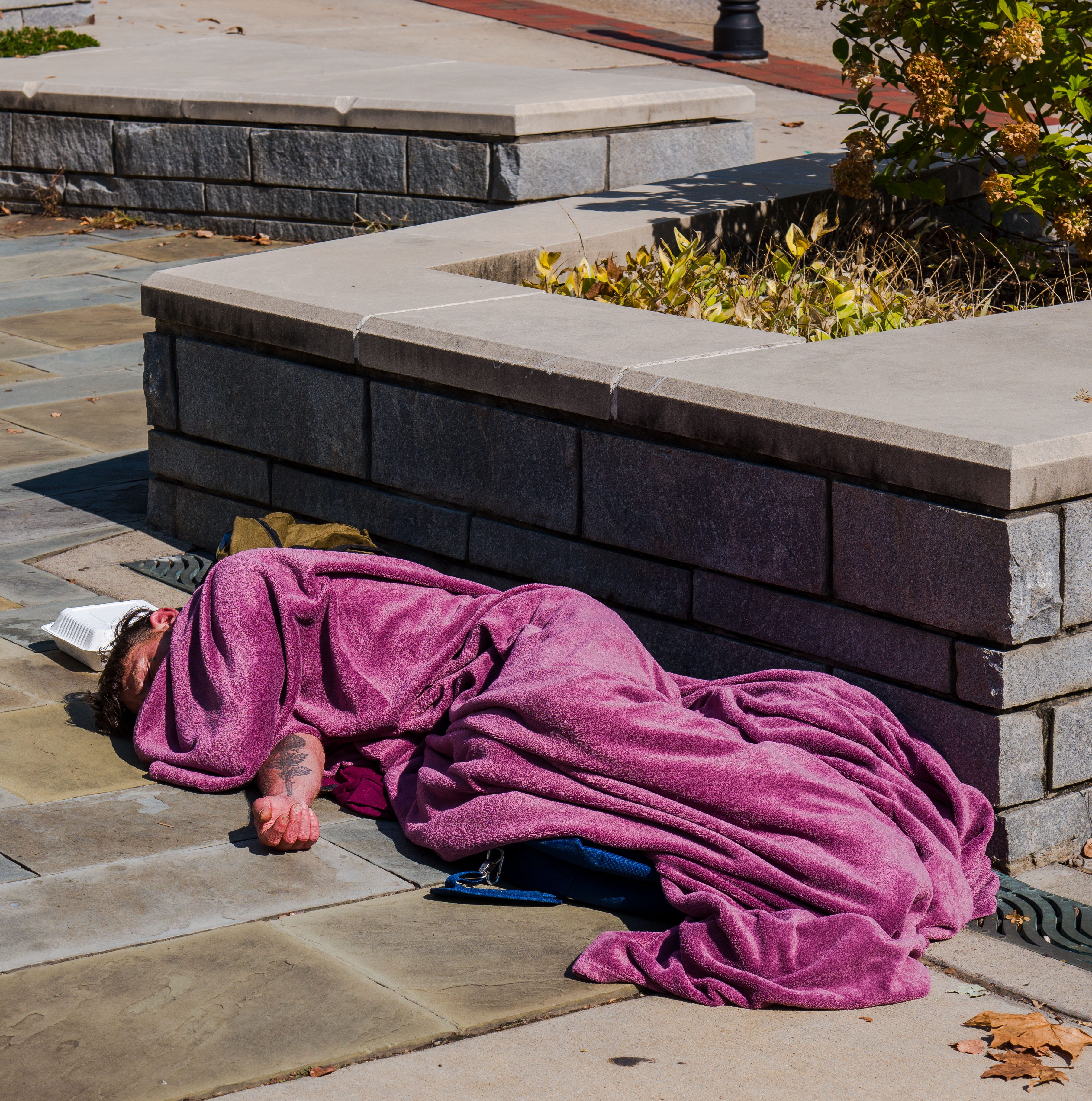
A purple blanket covers most of his body. His head rests close to a food container; one arm extends onto the stone, the palm turned upward. A blue bag lies partly beneath the blanket. Behind him, the broad sides of a raised planter give the photograph its dominant shape.
There is a great deal of planning visible here. Stone has been cut and fitted. The planting has a defined bed; the paving and drainage have their places. The setting records the work of making a shared space usable and presentable. At its base, a person lies on the ground.
I find that proximity difficult to set aside. We have a developed understanding of what a public place requires: surfaces, planting, drainage, maintenance. Those practical concerns belong in any account of how we live together. So does the person who has spread a blanket beside the planter. His need for somewhere to live deserves organised attention and a response that lasts.
The blanket introduces something familiar from a bedroom into this carefully built setting. Its folds gather around a body supported by paving stones. It offers a covering in a place where so much else that would make rest comfortable and secure is absent.
A photograph can bring these things together so neatly that the arrangement begins to seem complete. I am wary of that satisfaction in my own looking. The strong geometry and the colour of the blanket hold my attention; the circumstances require me to think beyond what works within the frame.
Our care for public space should extend to the people living in it. The person beside the planter needs a home.
photographs and commentary courtesy:
Will Hazlitt, R9 Media Photo Collective