Photos Inside an Abandoned Drug Den - The Persistence of What Remains
A space emptied of intention, but not of evidence
There is no moment here, only residue.
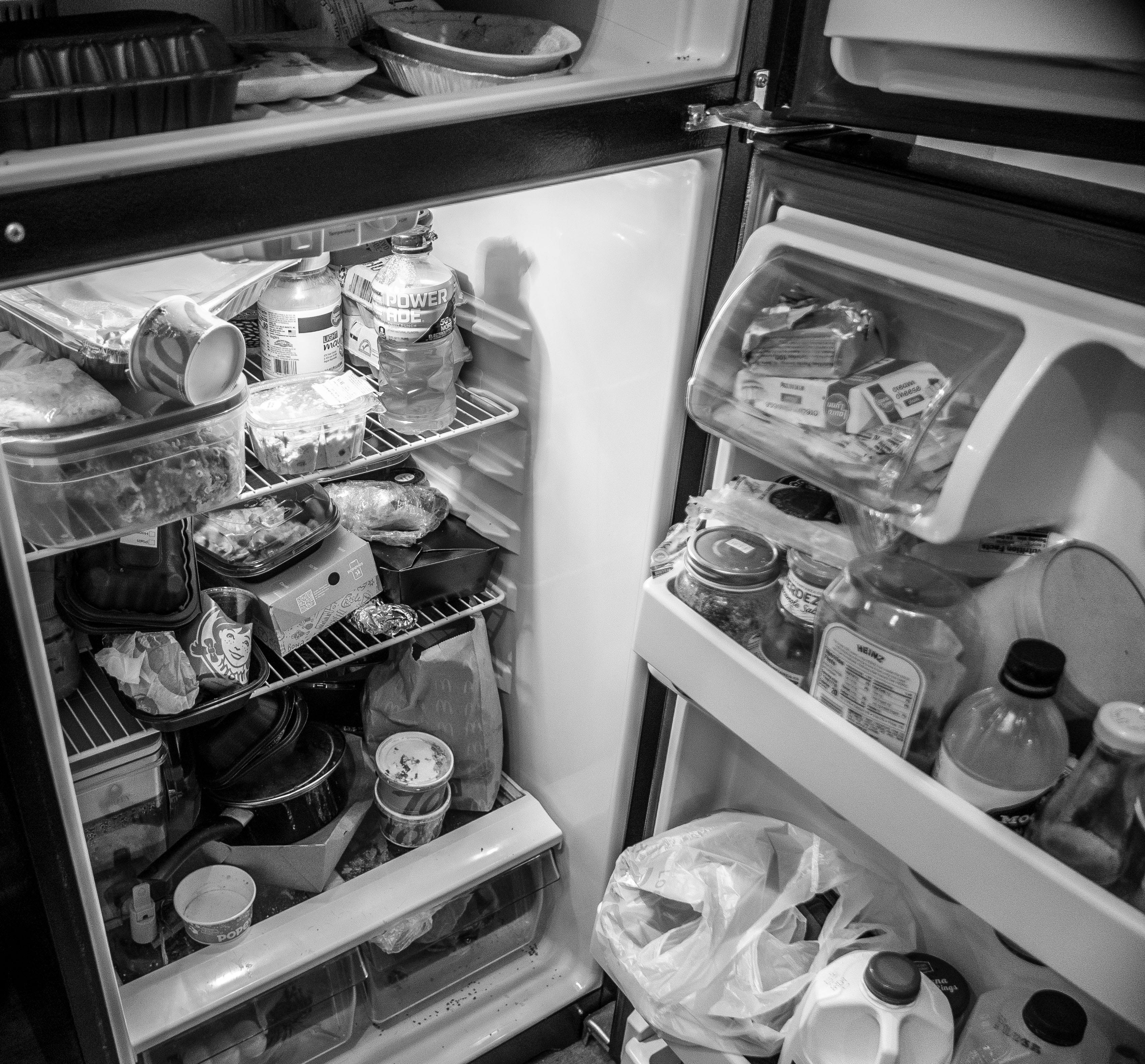
A refrigerator still holds what someone intended to return to. Containers are stacked without care, but not without purpose. Drinks remain half-considered. A freezer carries the logic of preservation, even as nothing within the space appears to have been preserved. It is not neglect in the immediate sense, but something slower—an erosion of intention that leaves function intact while meaning slips away.
A figure stands partially turned, neither subject nor intruder, but something closer to a witness. The posture suggests hesitation, or perhaps recognition, as if the act of looking itself requires adjustment. Nothing in the room resists observation, and yet nothing offers itself fully to it.
The table suggests order that was never sustained. A binder lies open, its contents concerned with the human body—anatomy, physiology—rendered in the language of structure, systems, coherence. It is the kind of material that assumes a body can be understood, mapped, accounted for. Here, it rests without commentary, its clarity intact but its context displaced. Nearby, a hanger lies flat, no longer serving even the minimal function it was designed for. The objects do not contradict one another; they simply fail to align.
There is, however, a presence that exceeds what can be seen. A chemical odor, sharp and insistent, occupies the air with a kind of authority the images cannot reproduce. It is not tied to any single object, nor does it reveal its origin. It lingers as a condition rather than an event—pervasive, inescapable, and ultimately untranslatable. The photographs remain silent on this point, and in doing so, they remain incomplete in a way that feels appropriate.
The architecture of the space continues to perform its intended functions. Doors open. Closets hold. Cabinets close imperfectly, or not at all. The bathroom retains its fixtures, its reflective surfaces, its suggestion of routine. Yet each of these elements appears slightly misaligned with its purpose, as if use has outpaced care. The hole in the door is the only overt gesture toward violence, but even that reads less as an incident than as a remainder. It has already passed into the background of the space, absorbed into its general condition.
Carpeted surfaces carry the most persistent traces. Impressions remain where objects once rested. Debris settles into fibers, resisting easy removal. The floor records duration rather than action, the slow accumulation of presence rather than any single decisive moment. In the larger room, light enters through broken blinds, diffused and uneven, illuminating nothing in particular. A candle sits unlit. A piece of clothing has been left behind without indication of return. The room does not appear abandoned in haste; it appears abandoned in stages.
There is no narrative here that insists on itself. The evidence does not cohere into explanation. Even the knowledge that the space was used for the consumption of illicit substances does not clarify what is seen. It only adds another layer of abstraction, another condition that resists visualization. The images do not confirm it. They do not deny it. They remain, instead, committed to what is observable, and to the limits of observation itself.
What persists is not chaos, but neglect. And neglect, unlike chaos, does not announce itself. It does not disrupt so much as it withdraws. It allows structures to remain while intention recedes. It leaves behind objects that continue to exist without context, without urgency, without claim.
The space is not empty. It is simply no longer inhabited in any meaningful sense. What remains is the trace of use without the presence of the user, the outline of a life that has moved elsewhere or ceased to cohere. Nothing here asks to be understood. It only asks to be seen, and even that feels like more than it requires.


