The Distance of Looking
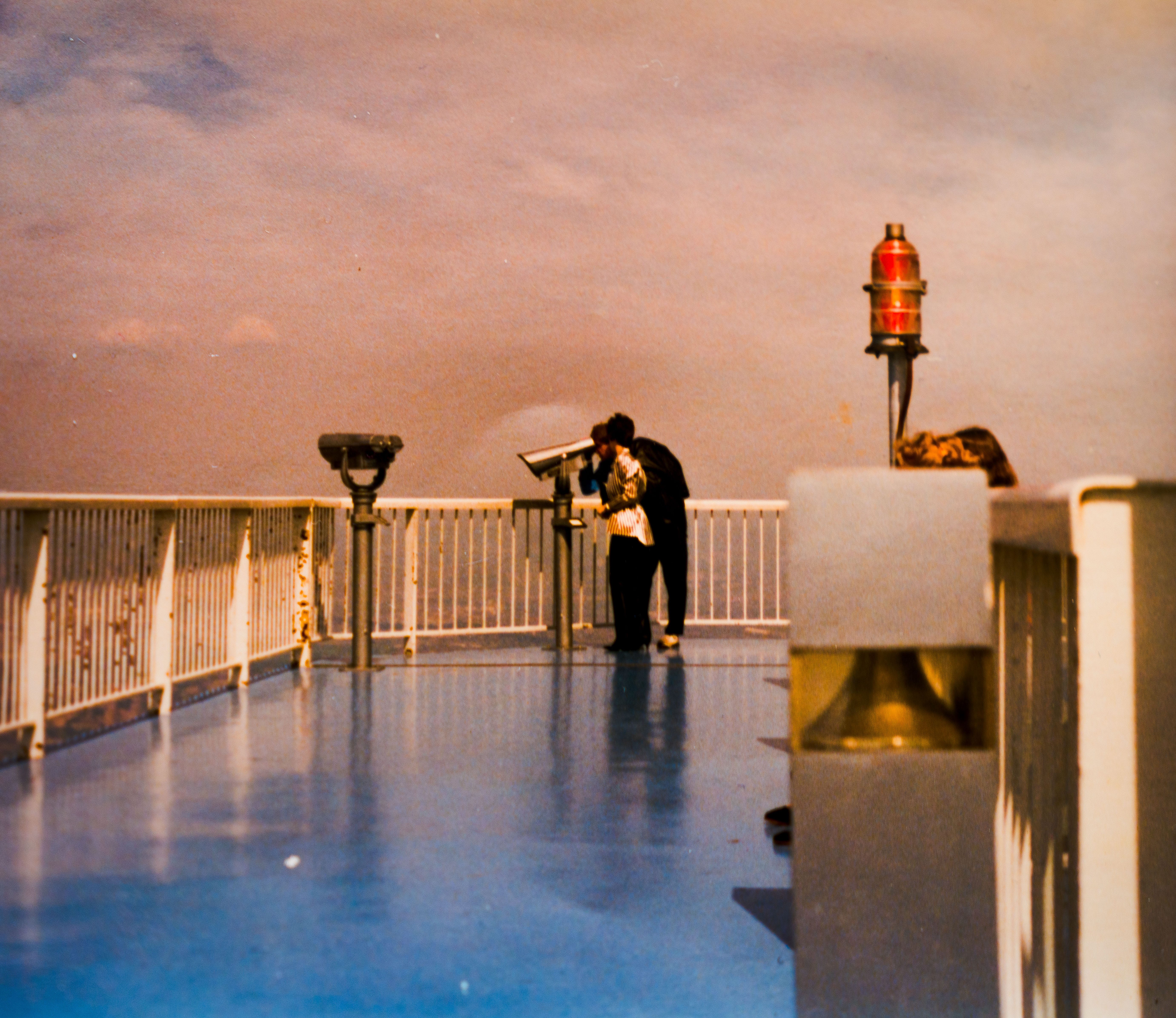
A rephotographed 1980 observation deck image by Allan Smessaert—reseen through a Leica Q3 43—as a meditation on vantage, recursion, and the quiet persistence of human curiosity across time.
What strikes me first is not the subject, but the distance—the quiet, almost reverential distance this image insists upon. The figures are small, nearly swallowed by the geometry of the observation deck, and yet they anchor the entire frame. A couple, or perhaps simply two people momentarily aligned, leaning into one of those coin-operated viewers that promise access to the horizon but deliver, instead, a curated fragment of it. That gesture—of looking outward from a place already elevated beyond necessity—feels central to me. It is a doubling of perspective: to stand atop the World Trade Center in the summer of 1980, already above the city, and still feel compelled to look further, to magnify distance, to search for something just beyond reach.
Knowing this was originally captured by Allan Smessaert on a Leica M using Kodak film situates the image firmly within a lineage of observational discipline—one that resists spectacle in favor of quiet structure. There is nothing hurried here. The composition is patient, almost architectural in its restraint. The railings guide my eye laterally, while the receding deck creates a shallow corridor that draws me toward the figures without ever collapsing the space between us and them. I don’t feel invited into the scene so much as permitted to observe it, and only at a remove.
My act of rephotographing this image—now with the Leica Q3 43—introduces a second temporal layer that feels far more than technical. It becomes interpretive, even philosophical. This is no longer simply a photograph of a moment in 1980; it is a photograph of a photograph of that moment, seen through my own sensibility decades later, looking back at an image that was itself about looking. The recursion is subtle but, to me, quite profound. The original gesture—two figures peering outward—is mirrored in my own gesture of re-seeing, re-framing, and re-presenting.
The adjustments I’ve made—cropping, color correction—may be minor in execution, but they carry weight in how the image now breathes. The warmth that permeates the photograph, that slight amber cast, lends the scene a kind of suspended atmosphere. It feels less like nostalgia and more like residue, as if the image has absorbed time rather than merely survived it. The blue of the deck, slightly muted, plays against the warmth of the sky and the red signal light on the right—a small but critical counterpoint that keeps the palette from drifting. That red light becomes a kind of quiet punctuation mark: fixed, functional, and indifferent to the fleeting human presence at center.
What I find particularly compelling is how the photograph resists the gravitational pull of its own historical context. It would be easy to read this image through what the World Trade Center would later come to represent, but I find myself resisting that instinct. I want to let the photograph remain where it was—in 1980, in a moment of ordinary human curiosity. And yet, in rephotographing it now, I can’t entirely escape what I know. The image seems to hover for me between innocence and hindsight, never fully settling into either.
There is also a tension here between intimacy and anonymity that I can’t ignore. The figures are close to one another—physically intimate in their shared act of looking—but they remain indistinct, almost archetypal. They could be anyone. That anonymity matters, because it allows me, as the viewer and now as the one re-presenting the image, to project into it without constraint. The photograph becomes less about them and more about the act itself: the human impulse to seek vantage, to elevate oneself, to look out and, perhaps, to understand one’s place in relation to what is seen.
I’m also aware, in rephotographing this, of the material life of the original print. There’s a softness at the edges, a slight degradation that speaks to its physical history. But rather than diminishing the image, this deepens it for me. It reminds me that photographs are not just images; they are objects that age, that travel, that accumulate the marks of time and handling. My intervention here is not about correcting that history, but about extending it—allowing it to continue, to be seen again, differently.
In the end, what I’m left with is not simply a document of a place or a moment, but a layered meditation on seeing itself. Smessaert’s original act of observation, my act of re-observation, and the viewer’s act of looking now—all of these seem to exist within the frame at once. The photograph becomes, for me, a kind of temporal corridor—not unlike the deck it depicts—through which the eye travels, guided but never confined, always aware that what is seen is only part of something larger, and ultimately unknowable.
- Will Hazlitt, R9 Media Photo Collective


