

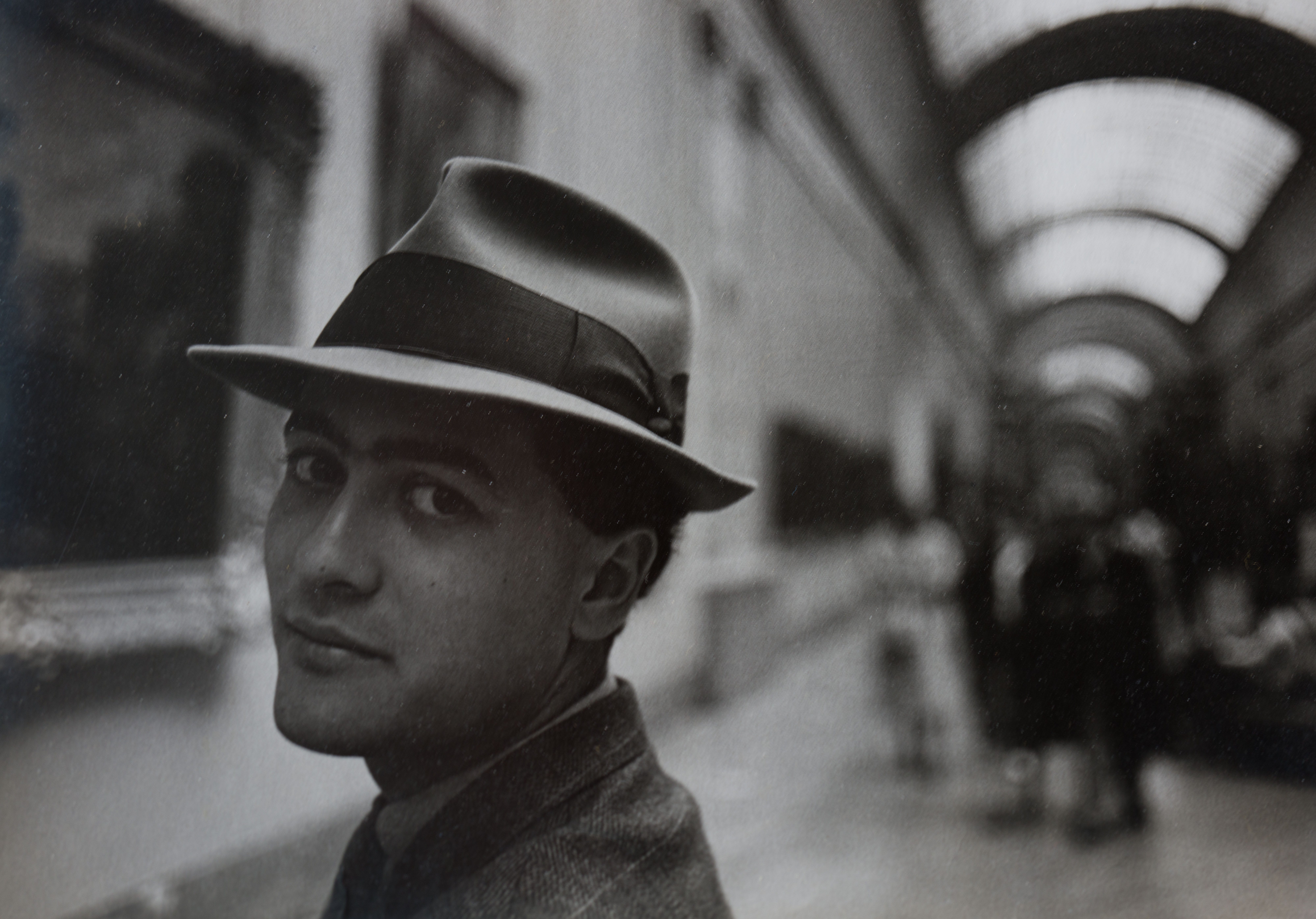
Original photo courtesy the photographer:
Lisa Howe-Ebright
Taken on a Leica M on Ilford film in 1979 at the Musée du Louvre-Paris, France
In 1979, inside the august corridors of the Musée du Louvre, Lisa Howe-Ebright made a photograph on a Leica M using Ilford film. It is, at first glance, a modest image: a man in a fedora, turning slightly, his face illuminated by the soft interior light of the museum. The paintings behind him recede into blur. The Louvre, that immense theater of cultural validation, becomes backdrop rather than protagonist.
This inversion is not accidental.
The museum is constructed to direct our gaze toward sanctioned masterpieces — toward what history has already approved. Yet Howe-Ebright’s frame refuses that directive. The subject does not gaze at the art. Nor does the camera. Instead, the photograph attends to the living presence situated within the institutional space. The canon stands behind him; consciousness stands before it.
There is something quietly radical in that orientation.
The Ilford grain lends the image its particular tactility — a silver atmosphere that breathes rather than insists. The tonal compression of film produces a softness around the edges of the gallery walls, allowing the fedora’s clean line to assert itself against the architecture. The subject’s glance is neither staged nor defensive. It suggests awareness — of the photographer, of the moment, perhaps even of being observed within a space dedicated to observation.
Decades later, the image is rephotographed on a Leica Q3 43 and lightly edited — undertaken with the full permission of Lisa Howe-Ebright. This detail is essential. The act is not extraction; it is collaboration across time. Rephotography here does not erase authorship but extends it. It acknowledges origin while introducing mediation.
The digital sensor renders micro-contrast differently than silver halide. Blacks settle with a different authority. Edges clarify. The grain, once inherent to emulsion, becomes an artifact of history, now reframed. Yet what remains untouched is the psychological nucleus: the eyes. They carry forward with undiminished presence, bridging 1979 and the present moment.
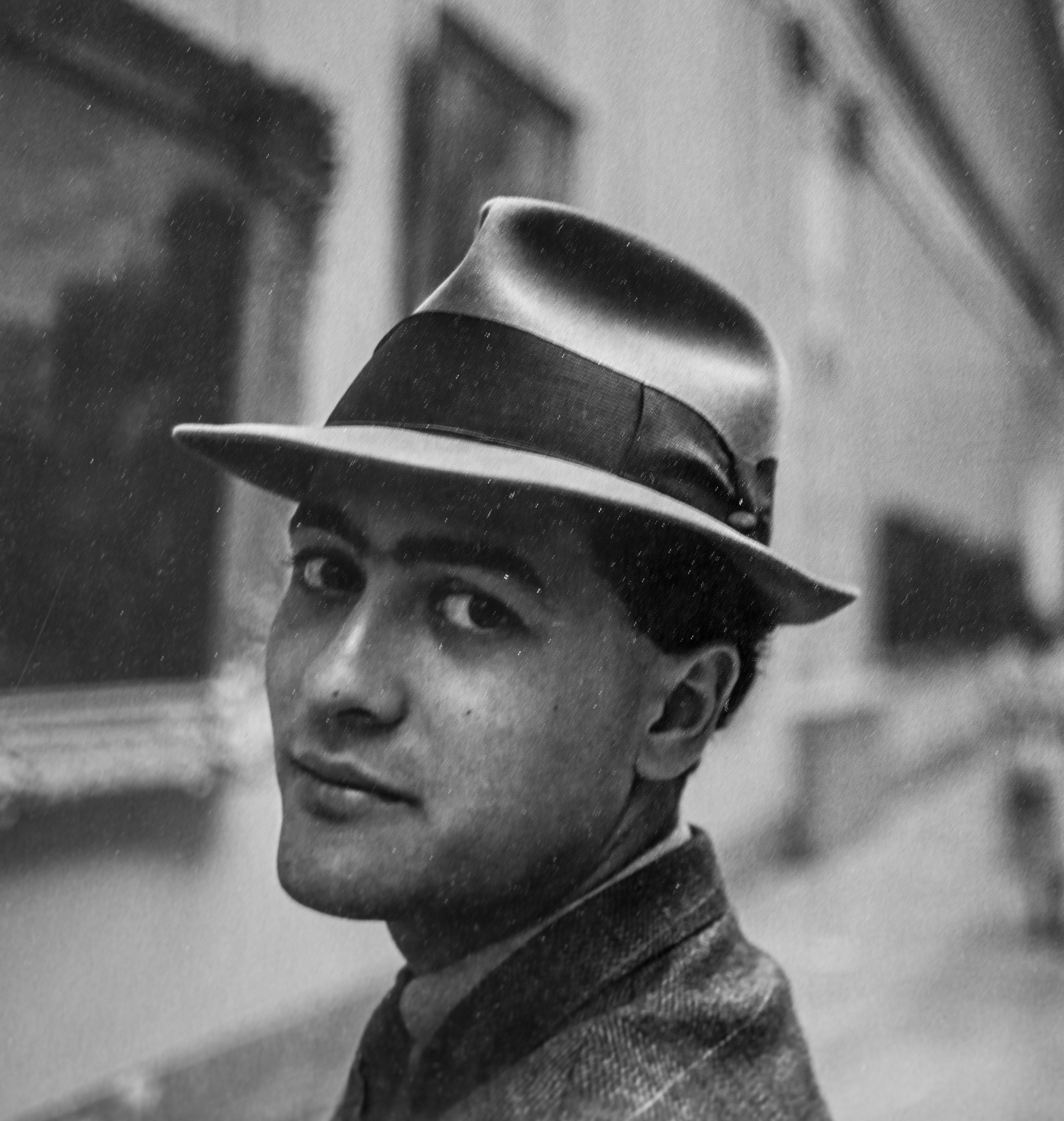
Rephotograph of original 1979 photograph
Courtesy: R9 Media Photo Collective
Photographer: W. Hazlitt
Studio Assistant: A. Smessaert
Video courtesy: R9 Media Photo Collective
What emerges is a layered authorship — not competitive but sequential. The original image belongs to its era: a late-1970s museum, a young man caught between looking and being looked at. The rephotograph belongs to ours: a time preoccupied with archives, with memory, with recontextualization. In bringing the image forward, the contemporary gesture does not claim ownership; it claims conversation.
It is also worth noting that the Louvre itself functions as silent co-author. Museums are institutions of hierarchy. They determine which objects merit preservation, which narratives endure. Yet in this photograph, the institution is destabilized. The living subject eclipses the paintings. The canon fades into bokeh. The hierarchy dissolves.
To turn away from the art on the wall and toward the person in the room is not merely compositional. It is philosophical.
The image reminds us that history is not only what hangs in frames. It is also the unnoticed figure passing through the gallery, the fleeting glance, the human presence temporarily intersecting with monumental culture. Rephotography amplifies this realization. By reintroducing the image into contemporary circulation — with permission, with acknowledgment — it asserts that photographs themselves are living entities. They accrue meaning as they move through time.
This is not nostalgia. It is continuity.
In the end, the most striking element remains the subject’s orientation. His body is angled away from the masterpieces, yet his eyes meet the camera. He stands between centuries of art and the immediacy of the present gaze. He becomes, briefly, the axis upon which time rotates.
And perhaps this is the quiet thesis of the work: that the canon is stable only until someone turns away from it — and looks elsewhere.
- Élodie Vasseur
Paris, France 2026
R9 Media Photo Collective
https://vero.co/r9media

